Journal of Camus Studies 2025
Contents
Editor’s Introduction
PETER FRANCEV
Faith and Absurdity: Revisiting James Woelfel’s Camus: A Theological Perspective Fifty Years On
ERIC BERG
Albert Camus: Secular Saint or Good-Willed Colonizer? A Reassessment of Exile and the Kingdom
AOIFE CONNOLLY
Jean-Baptiste Clamence and the Fall of Empathy, Part II
PETER FRANCEV
Albert Camus and the Critique of Sacrificial Logic: Revolt, Violence, and Moral Limits
AUDREY GARZEND
Revisiting Sisyphus: The Importance of Fluidity in Albert Camus’s and Samuel Beckett’s Absurdist Works
IVAN NYUSZTAY
Fanon and Camus: Depersonalized Subjects in the Colonies
DHAYNA RAGHAVAN & MIROSH THOMAS
Closing His Eyes to the Double in Nietzsche? On Camus’s Nietzsche, Nietzsche, and Their Critics
MATTHEW SHARPE
Journal of Camus Studies: Manuscript Submission Guidelines
Abstracts
Faith and Absurdity: Revisiting James Woelfel’s Camus: A Theological Perspective Fifty Years On
ERIC BERG
In this paper I will revisit James Woelfle’s (1937-present) classic book Camus: A Theological Perspective published in 1975 by Abingdon Press and place in into a larger scholarly framework. Woelfel was appointed Professor of Philosophy and Religion at the University of Kansas in 1966 where he taught across several departments until his retirement in 2015. His Camus book was published in 1975 and although initially suffering critical reviews, the book grew to be a significant offering in the area of Camus studies, especially for scholars who work on theological and religions questions raised by Camus. In the end I will offer a framework of historical Camus scholarship that helps situate Woelfel’s text in the canon of Camus studies.
Albert Camus: Secular Saint or Good-Willed Colonizer? A Reassessment of Exile and the Kingdom
AOIFE CONNOLLY
The École d’Alger [Algiers School] was a literary movement of the mid-1930s to the 1950s that focused on a united Mediterranean identity. Albert Camus was the school’s most famous writer. Yet many critics have effectively ignored his Algerian origins in favor of universalist readings of his works. As Germaine Bree noted in 1960, a legend surrounding the author has tended to transform him into “une sorte de saint laïque” [a kind of secular saint]. Conversely, scholars have periodically drawn attention to Camus’s roots in harsh postcolonial critiques. His most famous critics include Conor Cruise-O’Brien, Edward Said, and Albert Memmi, who in 1957 labelled Camus a “colonisateur de bonne volonté” [good-willed colonizer]. While more recent analyses seek to rehabilitate the author, this article reappraises the two opposing views of Camus – as either a good-willed colonizer or secular saint, by examining tensions that arise in his fiction, specifically in a collection of his short stories, L’Exil et le Royaume [Exile and the Kingdom] (1957), most notably the collection’s three stories that are set in Algeria – “La Femme adultère” [The Adulterous Woman], “Les Muets” [The Mute Men], and “L’Hôte” [The Guest/Host]. The article examines Camus’s contested legacy with regard to colonial Algeria and offers insights into his contradictory position as both a humanist and a member of the colonizing community. It also sheds new light on Camus’s use of fiction to grapple with his conflicted identity.
Jean-Baptiste Clamence and the Fall of Empathy, Part II
PETER FRANCEV
At the 2024 Albert Camus Society Conference I presented a paper entitled ‘Jean-Baptiste Clamence and the Fall of Empathy’ in which I examined Jean-Baptiste Clamence, the protagonist from The Fall, from the perspective of empathy as related through the stories that he revels to the unnamed bar patron in the seedy ‘sailor’s bar’ Mexico City. For the sake of time, I was only able to cover the first two nights of the four-night encounter between the protagonist and his interlocutor-antagonist. The purpose of this paper is to continue with the analysis of Clamence through the third night whilst examining Clamence’s attitude towards the role of empathy in his life.
Albert Camus and the Critique of Sacrificial Logic: Revolt, Violence, and Moral Limits
AUDREY GARZEND
The engaged thought of Albert Camus is deeply shaped by the political and moral crises of the twentieth century. Claiming a profoundly Mediterranean identity, Camus is also influenced by an ancient and biblical heritage that informs his reflection, as evidenced by the mythological figures associated with the three cycles that structure his work. This article proposes to reread Camus through the lens of sacrificial logic. By examining anthropological and religious theories of sacrifice—from pagan rituals to the Christian allegorization of sacrifice—it argues that sacrificial structures influence both the thought of the absurd and that of revolt, where motifs drawn from the sacrificial imaginary repeatedly appear. This raises the question of whether it is possible for an engaged writer to escape sacrificial logic, particularly when he cannot endorse the legitimization of violence. Camus thus develops a critique of sacrificial logic, especially when it serves to justify violence in the name of religion, ideology, or history. His characters who resort to sacrifice reflect his commitment to measure and balance, as well as to justice and fraternity, which animate both his entire body of work and his ‘‘La Pensée de Midi’’. Through figures such as Prometheus and the political dilemmas explored in his writings, Camus—rather than rejecting sacrifice altogether—offers variations on this theme and questions how the sacrificial impulse might be re-situated within a human order.
Revisiting Sisyphus: The Importance of Fluidity in Albert Camus’s and Samuel Beckett’s Absurdist Works
IVAN NYUSZTAY
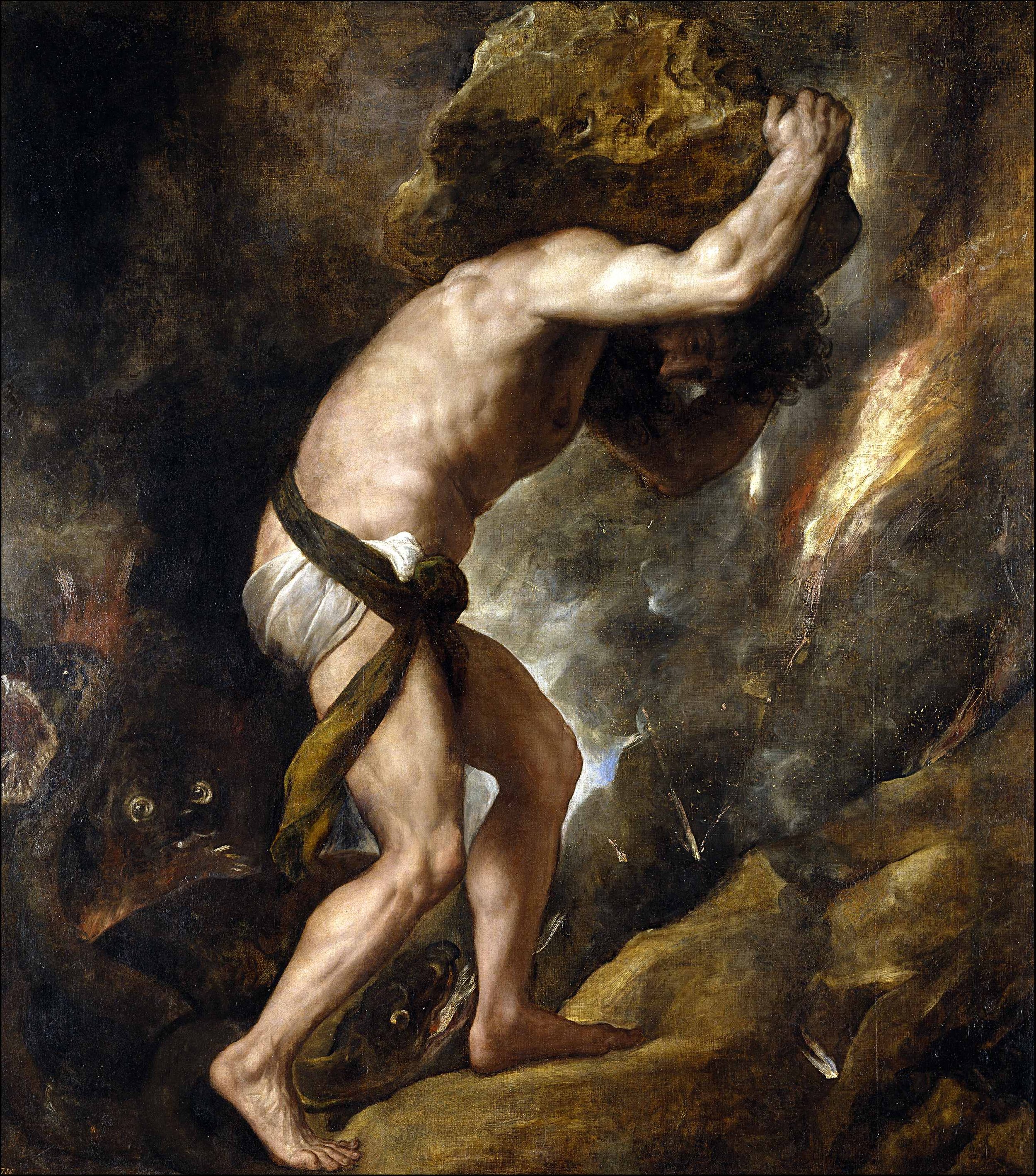
As Camus notes in the last section of his The Myth of Sisyphus, ‘The lucidity that was to constitute his torture at the same time crowns his victory’ (La clairvoyance qui devait faire son torument consommé du même coup sa victoire). As Camus tells us, Sisyphus is ‘superior to his fate. He is stronger than his rock’ (il est supérieur à son destin. Il est plus fort que son rocher). In my reading, Sisyphus’s avowed strength championed so steadfastly by Camus turns out to be a cloak for the underlying weakness. Caligula is more straightforward about this incapacity when he complains about being powerless to possess the moon, his desire for the impossible, or overrule the motion of the earth (his rocks), ‘I can’t have the sun set in the east’ (je ne puis faire que le soleil sa couche à l’est). Nevertheless, as Sisyphus, he will never give up the desperate search for the impossible. Rereading The Myth in the light of the play further confirms our qualms about Sisyphus’s unique powers and achievements. Neither does the protagonist of The Stranger appear ‘victorious’ in any sense, since he is grotesquely depersonalized throughout the novella and eventually sentenced for his crime. Yet in the same section of the treatise, we find another, easily bypassed, potential source of strength: water. The rock here is set against water, the merciless punishment against hope and benediction. Camus’s portrayal of Sisyphus’s toils therefore appears in a different light as the focus shifts from rock to water. The latter gains utmost importance not only as an element on earth Sisyphus dotes on but as a factor that affects the constitution of selfhood and the whole concept of homo absurdus. There are then two Sisyphuses. One discovering the utter futility of his endeavours and embracing a radical Cynicism regarding man’s everyday aspirations. But, at another level, there is the other Sisyphus, who turns fluid and demonstrates the failures of Cynical reason and the need for relationality.
Fanon and Camus: Depersonalized Subjects in the Colonies
DHAYNA RAGHAVAN & MIROSH THOMAS
Albert Camus’s short story “The Guest” (1957) has been widely studied for its depiction of the Algerian War of Independence. While conventional scholarship focuses on the moral dilemma or philosophical neutrality, this paper uses Frantz Fanon’s revolutionary psycho-social framework to examine the psychological trauma of colonialism. Fanon’s concept of “depersonalization” is used to analyze how systemic violence dehumanizes both colonizers and colonized. By reading Camus’s text against Fanon’s critiques of colonial psychiatry, particularly his refutation of Eurocentric biological determinism and Octave Mannoni’s “dependency complex,” the paper reveals that the characters’ behaviors are symptomatic of a socially induced, structural pathology rather than personal neuroses. This Fanonian reading illustrates that colonial warfare and epistemic negation create a deep sense of self-alienation, dual consciousness, and internal exile in the colonized subject. Ultimately, this overwhelming ontological trauma shatters the native Arab’s capacity for autonomous agency, leading to his tragic choice of imprisonment over freedom. This despairing surrender mirrors the moral depersonalization, paralyzing ethical evasion, and broken judgment of the “benevolent” French-Algerian schoolteacher, Daru. By bridging literary analysis with historical ethnopsychiatry, this paper offers a rigorous model for using Fanon’s clinical theories as textual tools, proving that systemic colonial violence corrupts the ethical and psychological fabric of all participants.
Closing His Eyes to the Double in Nietzsche? On Camus’s Nietzsche, Nietzsche, and Their Critics
MATTHEW SHARPE
This paper offers a critical response to critics of Camus’s 1951 critique of Nietzsche. Part 1 addresses Aymeric Monville’s claim that Camus effectively participates in what Domenico Losurdo has called the “hermeneutics of innocence” surrounding Nietzsche in his liberal and postmodern, anglophone, Italian, and francophone receptions. We contend that, unlike the other French readers of Nietzsche with whom Monville aligns him, Camus proffers a forthright criticism of Nietzsche which precisely takes into account the darker contents of the German thinker’s later works which undergirded Nietzsche’s fascist and Nazi appropriations. In part 2, we show how William E. Duvall by contrast sees that Camus proffered a forthright critique of the political dimensions of Nietzsche’s later work, only to questionably dismiss Camus’s critique and subject it to a psychologising reading: of Camus as feeling compelled to stand in subjective judgement over his philosophical hero as part of his own intellectual individuation. In part 3, we argue that Duvall’s psychologising of Camus’s criticisms of Nietzsche is unjustified, based on evidence from Nietzsche’s texts, which bear out directly Camus’s central claims concerning the “dynamitic” illiberal contents in the thought of the German philosopher.